
I was recently shamed for asking about my own identity. I was told, quite bluntly, that I hadn’t asked “in a nice way”. The feedback focused entirely on my behaviour, shifting the blame onto my delivery rather than acknowledging the profound, fundamental knowledge I was seeking. Apparently, my question hurt the recipient, and that became the priority.
When I re-read the messages now, in the cold light of day, I can see the bluntness. I don’t deny it. I can admit it wasn’t the gentlest way to ask. But when I look at those messages, I feel the frustration that lived underneath them. I feel the years of silence, the decades of ambiguity, the exhaustion of asking the same questions over and over again and receiving nothing in return.
For many adoptees, identity is not a given. It is not a simple fact of life. It is something you spend years trying to piece together, often with very little to work with. That is the context I carry into every conversation about my beginnings.
I was a relinquished baby, given up by a young unmarried mother whose parents were unwilling to support either her or me. I grew up knowing I was adopted. I always felt a little like a square peg in a round hole, but I never doubted that I was loved. My parents’ love was real, true and honest. The problem was that the information I had about my beginnings was limited and, as I later discovered, inaccurate.
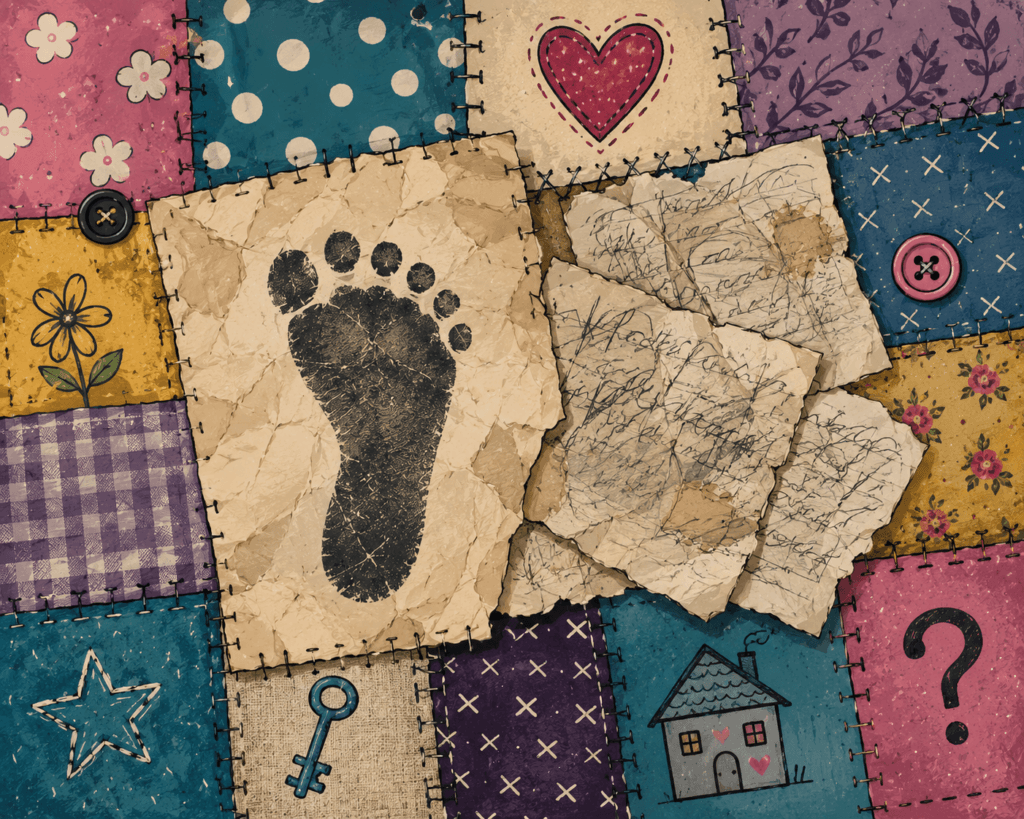
My official paperwork sits in a blue file in my office. It should have held my story. Instead, apart from a handful of basic facts, it holds very little at all. It is a blank canvas of dead ends, made worse by the fact that my birth mother later admitted she had lied on some of it.
I have literally been asking questions about who I am for over twenty years. That kind of prolonged ambiguity does something to a person. It leaves a mark. It wears away at you, leaving a raw, desperate need for the truth.
I have spent years trying to understand where I came from, who I came from, and why. Not because I was looking for another family. Not because I was looking for another mother. Not because I lacked love.
I wasn’t looking for her. I was looking for me. When I first began the journey to find my birth mother all those years ago, I didn’t come carrying anger or resentment. I came to thank her. I wanted her to know that I understood she had made an impossibly difficult decision. I wanted her to know that I had been deeply loved, that I had grown up knowing how to love in return, and that I remained proud to be adopted.
Love is love.
I know a small piece of her story: she was threatened with homelessness by parents whose religion and shame left little room for compassion towards an unmarried pregnant daughter. Society offered little support to women in her position. I have always understood that. In many ways, my anger has never been directed at her. It has been directed at the circumstances, the secrecy, the silence and the years of unanswered questions.
Over time I have come to understand something important: being relinquished may not sound the same as being unwanted. For a long time I tried to keep them separate, but in many ways they are tangled together. Cognitively, I know she did not place me for adoption because I was unwanted. I know she was trapped by circumstances. I know she was frightened. I know she had very few options.
Emotionally, however, things are not quite so simple. When every attempt to understand your origins is met with distance, silence, rejection or conditions, it is hard not to internalise that as being unwanted. My head understands one reality; my heart often feels another. Both truths sit side by side within me.
I know some people would say that means I wasn’t unwanted. I see it differently. I was deeply wanted by my parents. Fiercely loved, chosen and cherished. But my experience of my birth family has often felt very different. Years of distance, silence, rejection and conditions leave their own mark. Being profoundly wanted by one family does not erase the experience of feeling unwanted by another.
But throughout our sporadic contact, in all of her limited and guarded words, I have never once seen myself reflected. I only ever saw her—her needs, her defences, her fears and her overwhelming desire to keep me at arm’s length.
Perhaps that was another shock. I went looking for pieces of myself and found very little that felt familiar. I found someone closed where I am open, guarded where I am direct, and so entrenched in her own pain that there seemed little room left for mine. I do not say that without compassion because life clearly wounded her deeply. But I would be lying if I said it did not unsettle me.
For years I wondered what parts of her I might find in myself. Instead, I found myself relieved that I didn’t recognise much at all. The older I get, the more I realise how different we are. I spend much of my life trying to understand other people, sitting with difficult emotions, hearing painful stories and making space for experiences that are not my own. The apparent inability to do the same for me has been one of the hardest things to reconcile.
I see her pain. I respect the trauma of her past greatly. But I wasn’t asking her for a deep emotional connection. I wasn’t demanding her time. I wasn’t asking her to mother me. I was simply asking for pieces of myself. I was looking for a shred of validation and some basic human understanding of how I came to be in this world.
At one point she even told me she didn’t know whether I would be allowed to know my own identity. Think about that for a moment: not allowed to know who I am. Yet when I expressed frustration that I wasn’t even permitted a paragraph more of information, the conversation became about my behaviour. I hadn’t asked in a nice way. Please note this was a sign of impatience as I had been asking for years.
Again.
I know my etiquette probably wasn’t right, but is there a specific etiquette for asking how and why you were created and by whom? It is difficult to maintain perfect manners whilst navigating a minefield where multiple biological relatives have made it abundantly clear, albeit politely, that you remain an inconvenience at best and an unwelcome disruption at worst.
The one family member who does express a desire for a relationship with me does so with conditions attached. I am expected to stay in my lane, remain in my box, not upset the status quo, and respect their boundaries. I want to, but at the same time my inner voice is shouting. I won’t repeat what it is saying because, frankly, it probably isn’t very nice.
I understand that there is pain on the other side. In the last year I have heard repeatedly about my birth mother’s pain. I have heard about how difficult this is for her. I have heard about how upsetting these conversations are.
What I rarely hear is any acknowledgement of mine. Surely both things can be true. Surely her hurt and my hurt can sit side by side. I have never asked anyone to choose between them. Yet somehow her pain becomes precious whilst mine becomes problematic. Her feelings are protected, explained and accommodated. Mine are scrutinised, questioned and occasionally treated as evidence that I am the problem. After a while, that becomes hard not to notice.
Perhaps that is what sits underneath all of this. Not anger. Not entitlement. Not bitterness. A desire to be seen. I ask questions and receive critiques of my behaviour. I ask questions and receive explanations about other people’s pain. I ask questions and receive boundaries. What I rarely receive are answers.
Life has given me a unique perspective on all of this. I am adopted. I became a social worker. I later became an adopter myself.
If anything, those experiences have deepened my empathy rather than diminished it. They have taught me that family is not biology. Family is love, commitment, presence and showing up for one another. Family is the people who sit with you in your darkest moments. Family is the people who tell you hard truths because they care. Family is the people who stay. The contrast between the family I was born into and the parents who raised me could not be more stark.
My real parents — and by that I mean the people who adopted me, raised me, loved me and showed up for me every day — always spoke to me with openness, honesty and frankness. Whatever they knew, they shared. Whatever they didn’t know, they admitted. They validated my curiosity rather than treating it as a threat. They held space for my pain. They supported my search. They never once suggested that my questions were wrong. They had nothing to hide.
Because of my parents, I know what unconditional love feels like. This is not a story about a lack of love at home. Yet despite that secure foundation, the need to understand where I came from never disappeared. My DNA has sat on multiple registries for over a decade. I have searched. Waited. Asked. Hoped. And still, nearly fifty years into this life, I have never truly met someone who shares my DNA, save for a brief meeting with a birth aunt who was so unwell that it barely felt real.
Some people ask me why I keep doing this to myself. Why keep knocking on doors that remain firmly shut? Why keep searching? I don’t think I have a neat answer. All I know is that there is something profoundly strange about walking this earth for half a century and still feeling as though half of your story remains unknown.
And woven through all of this is the legacy of the era I was born into. A time when unmarried mothers were shamed, hidden, and pushed into decisions that were framed as moral necessities rather than human tragedies. A time when silence was encouraged, when reputations mattered more than relationships, and when the emotional needs of the child were rarely considered.
That generational shame didn’t just shape my birth mother’s choices; it shaped the landscape I have had to navigate ever since. It is the backdrop to the distance, the guardedness, the reluctance, the fear. It is the reason so many adoptees grow up with stories that are half-told or never told at all.
I am not separate from that history. I am one of its outcomes.
Being shamed for asking “the wrong way” has enraged me. Not because I completely disagree with their assessment. Looking back, I can see the bluntness. I can admit my words were not as gentle as they could have been.
What enrages me is that after decades of unanswered questions, after years of navigating rejection, silence and ambiguity, the focus once again became my delivery rather than my need.
The conversation became about whether I had asked nicely enough rather than about the profoundly human desire to understand who I am. Once again, the focus shifted towards protecting the eggshells surrounding her, so carefully laid over decades, rather than addressing the question underneath.
I still have a lot of processing to do around all of this. I am rejecting, and in some ways allergic to, the idea that I need to find closure. Closure feels like one of those words people use when they want you to stop asking questions that make them uncomfortable. I am not sure I will ever find peace with no answers, and I am not sure I should have to pretend that I have.
But one thing I know for certain is this: when you have been starved of the basic truth of your own identity for most of your life, you should not be expected to beg for the crumbs of your existence with perfect etiquette.
My delivery may not have been flawless. My frustration may have leaked out. My words may have been blunt. But my hunger for the truth was entirely justified. I have spent a lifetime fighting for answers, for understanding, for the people I love and often for people who have no voice at all. Perhaps I was blunt. Perhaps I was impatient.
But after nearly fifty years of unanswered questions, I will not apologise for wanting to know who I am.