

Since April 2023, PATCH has reached a milestone of 200 moments of holding space, sharing learning, contributing to conversations and working alongside families, professionals, researchers and policymakers to improve understanding of disrupted childhood development and create better outcomes for children and families.
PATCH’s work increasingly focuses on encouraging a whole-child perspective — understanding the child’s journey before birth, through infancy and childhood, and into the present day. It means considering the cumulative impact of prenatal experiences, intergenerational influences, trauma, loss, adversity, neurodevelopmental differences, relationships and lived experiences, alongside the strengths, needs and potential of each child, while recognising the challenges faced by the families caring for them.
Over the last three years, that concern has only deepened. Through engagement with families, practitioners, researchers, policymakers and organisations across the sector, a consistent picture has emerged. Many children who have experienced disrupted development are navigating the combined effects of trauma, loss, prenatal influences, neurodevelopmental differences, relational disruption and adversity. Yet professional understanding of these interacting factors remains inconsistent.
Too often, systems separate issues into categories — trauma, attachment, autism, ADHD, Foetal Alcohol Spectrum Disorder, mental health, behaviour, education or safeguarding — when children’s lives do not fit neatly into those boxes. The result can be fragmented responses that fail to see the whole child. Disrupted Childhood Development – Our Patch
PATCH’s work has increasingly focused on addressing this gap in understanding. Through conferences, webinars, research engagement, professional training and policy discussions, the aim has been to encourage a broader view of childhood development — one that considers the child’s full developmental journey, not simply the behaviours seen in the present.
This has led to the development of concepts such as the Journey of the Child and the HARM/SEEN framework, which seek to bring attention back to the child’s lived experiences, developmental needs and relationships. The goal is not to replace existing knowledge, but to connect research, professional expertise, practice wisdom and lived experience in ways that improve understanding and decision-making.
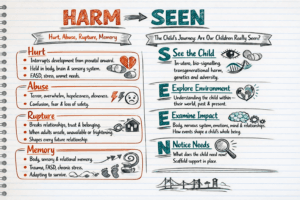
Feedback from professionals suggests this approach is resonating. Practitioners have described gaining a deeper understanding of children’s developmental journeys, recognising the importance of looking beyond behaviour and reflecting differently on their own practice. Many have highlighted the value of understanding the child behind the presentation rather than focusing solely on symptoms or incidents.
Alongside this work, PATCH has continued to support families experiencing crisis. However, the ambition has always been broader than crisis support alone. It is to contribute to a more informed, compassionate and developmentally aware understanding of children whose early experiences continue to shape their lives.
The conversations recorded across these 200 engagements point towards the same conclusion: children cannot be understood in parts. To support them effectively, we must understand the whole child, the whole journey and the whole context in which their development has taken place.
What We Have Heard While every family’s story is unique, common themes have emerged throughout PATCH’s 200 engagements.
Many families describe years spent seeking support before reaching crisis. Others speak about feeling blamed, judged or misunderstood when asking for help. Some describe being passed between services, with no single system taking responsibility for understanding the full picture of a child’s needs.
Families have shared experiences such as:
“We were blamed, ignored, threatened, lied to and about. Then I found PATCH and I felt I could breathe again.”
“I realised we are not alone — and we are not to blame.”
“For the first time in nearly 14 years, I didn’t feel so alone.”
“PATCH has been the difference between drowning and surviving.”
“I was on the brink of seriously considering taking my own life. I didn’t see a way forward.”
“PATCH gave me strength I never knew I had.”
“The only place where I can truly say things like they are without fear of judgement.”
“A place of acceptance, not blame.”
“We are the lived experience of a system not fit for purpose.”
Alongside the challenges, families have repeatedly highlighted the importance of being listened to, believed and connected with others who understand the realities of raising children affected by trauma, loss, adversity and disrupted development.
Professionals attending PATCH conferences, webinars and Journey of the Child training have also reflected on the impact of hearing lived experience alongside research and practice knowledge. Feedback has included:
“Hearing voices not usually heard in my work.”
“Professionals and adopters learning together.”
“A huge reminder that we must do better.”
“Eye-opening, urgent need for improved services.”
“Powerful, informative, essential for all in children’s services.”
“Hearing lived experience directly is powerful beyond measure.”
“The best conference of my career.”
“Important, thought-provoking and hopeful.”
Journey of the Child attendees have spoken about gaining a deeper understanding of children’s developmental journeys and the importance of looking beyond behaviour:
“It made me think about how important it is to look beyond a young person’s actions.”
“There is more to the young person than the paperwork we have to complete.”
“The training has made me question the way I think and feel, in a good way.”
“I will now re-evaluate how a child sees their own safety.”
“The training has helped me understand the complex backgrounds, journeys and experiences of children in care.”
Taken together, these voices point to a shared message. Families, practitioners and researchers are often reaching the same conclusion: children cannot be understood through behaviour alone. Understanding requires a fuller appreciation of developmental history, relationships, adversity, neurodevelopmental differences and lived experience.
The voices of our community must be heard and some of those are saying –
“We never failed our children, the system did.”
“Ignoring the needs of our children is an unforgivable travesty”
“we are members of a group nobody ever wanted to be in.”
“This community keeps families alive.”