There is a specific kind of grief that doesn’t belong to death, but feels entirely fatal. It is the raw, heavy ache of a house built for children that is suddenly, permanently quiet. When you have spent years pouring everything into your children, loving them fiercely and with the absolute belief of forever, the aftermath of a systemic crisis isn’t just a legal file; it is a living, breathing landscape of absence. It is looking at the height markings on the doorframe of a room that is now empty. It is setting the dinner table or planning a weekend, only to instantly realise the children who should be sharing those everyday moments with you are gone.
We hear so much from professionals promoting adoption. Yet those of us on the ground see the absolute tragedy left in the wake of social care decision-making that is too often insufficiently informed by science. This is exactly what PATCH fights for. We are deeply frustrated by the sheer volume of professionals and bystanders who choose to ignore this wreckage, allowing it to remain buried because there are no official statistics capturing this specific pain. Without data, these families, their experiences and their suffering are rendered invisible.
The mainstream narrative views family crises through a deeply flawed lens. Across the entire spectrum of permanence, life-changing decisions continue to be made without a sufficient scientific understanding of trauma, disrupted childhood development, neurodevelopment and the cumulative effects of adversity. This impacts families navigating the heartbreaking consequences of a Section 20 agreement when they could no longer safely manage high-risk behaviours at home without appropriate support. It impacts families surviving the trauma of what they believe to be an unjust removal. It also impacts families who remain together but are left completely stranded without evidence-based intervention to help them safely understand and manage complex presentations. Living with these extreme challenges whilst being blamed, left unsupported and watching your children go unseen by the very systems designed to protect them breaks people beyond what anyone should have to endure. This total lack of focus and insight is actively crucifying families.
Of course, we must always listen to children. Listening to them is fundamental. But listening without a scientific lens does not always mean we truly see or understand them. We are working with children whose development may have been profoundly shaped by trauma, prenatal adversity, disrupted attachment and neurodevelopmental conditions such as Foetal Alcohol Spectrum Disorder (FASD). When an overwhelmed child provides an account that is inaccurate, inconsistent or fragmented, a scientific lens first considers whether disrupted memory processes, confabulation, developmental trauma, suggestibility or neurodevelopmental differences may be influencing what that child is able to communicate. These are recognised clinical phenomena that require careful exploration, not assumptions.
Too often, statements are accepted at face value without sufficient consideration of the underlying science of memory, child development and neurobiology. Instead of exploring these deeper clinical explanations, systems can inadvertently weaponise a child’s internal confusion against the very parents trying to hold the family together.
For the parents caught within these processes, the powerlessness is unbearable. The system moves forward like a blind machine, stripping away school milestones, achievements and opportunities for inclusion one by one until families are left feeling completely broken. Legal avenues become exhausted, and life continues on autopilot—caring for elderly relatives, going to work, keeping a household functioning—whilst carrying a loss that society neither sees nor acknowledges.
But families are not hiding away. They are fighting every single day to be seen, refusing to allow this crisis to remain buried in the dark. It will never be enough to survive on memories when the present has been hollowed out by a flawed administrative narrative.
We must absolutely improve adoption support, but we cannot continue ignoring the front end of this crisis. Promoting adoption whilst failing to address the harm caused by poor accountability and decision-making that is not adequately informed by science is a betrayal of the very children permanence is intended to protect.
The greatest tragedy is not that the science does not exist. It does. The tragedy is that too often it is overlooked. Until decision-making is firmly grounded in child development, neurobiology, trauma, prenatal adversity and robust scientific evidence rather than assumption, more families will continue to experience avoidable crises. We cannot continue recruiting families into permanence whilst ignoring the systemic failures that place those very families at risk. Children deserve better. Families deserve better. Science demands better.
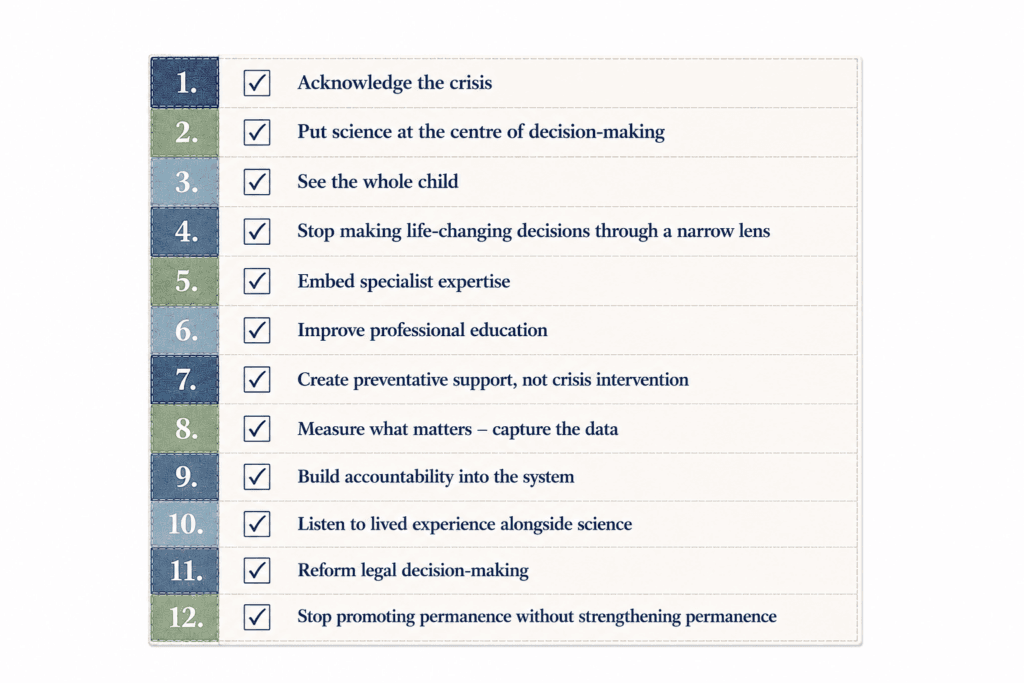
If We Are Serious About Protecting Children, We Must:
1. Acknowledge the crisis
Recognise that there is a significant crisis affecting children and families across adoption and permanence. Denial delays learning, prevents accountability and allows avoidable harm to continue.
2. Put science at the centre of decision-making
Ensure that every assessment, intervention and safeguarding decision is informed by current evidence in:
- Trauma and disrupted childhood development
- Neurobiology
- Neurodevelopment (including FASD, ADHD and Autism where relevant)
- Attachment
- Memory science and confabulation
- Prenatal adversity and transgenerational trauma
3. See the whole child
Move beyond behaviour, allegations and isolated incidents to understand the child’s developmental history, communication, lived experiences, relationships, biology and cumulative harm.
4. Stop making life-changing decisions through a narrow lens
Ensure that children’s accounts are explored within their developmental and neurological context, recognising that memory, communication and perception can all be influenced by trauma and neurodevelopment.
5. Embed specialist expertise
Professionals making high-risk decisions should have access to specialist consultation from clinicians and experts in trauma, neurodevelopment and child development, rather than relying solely on generic safeguarding processes.
6. Improve professional education
Mandatory training should move beyond awareness and embed evidence-based understanding of:
- Developmental trauma
- FASD
- Disrupted childhood development
- Memory science
- Complex communication
- Psychological safety
- The impact of cumulative adversity
7. Create preventative support, not crisis intervention
Provide specialist support early, before families reach crisis point, rather than waiting until relationships have deteriorated and risk has escalated.
8. Measure what matters
Collect national data on:
- Adoption and permanence disruption
- Children leaving adoptive homes
- Section 20 arrangements following adoption
- Placement instability
- Long-term outcomes for children and families
Without data, systems cannot learn.
9. Build accountability into the system
Develop mechanisms that allow organisations to identify patterns of poor practice, learn from mistakes and improve decision-making without defensiveness.
10. Listen to lived experience alongside science
Families, adoptees and practitioners all hold important knowledge. Policy should be informed through genuine co-production with those living the reality every day.
11. Reform legal decision-making
Ensure courts and safeguarding processes have access to the developmental science needed to properly understand children affected by trauma and neurodevelopmental differences.
12. Stop promoting permanence without strengthening permanence
Recruitment must be matched by equal investment in preparation, evidence-based support, accountability and long-term therapeutic provision.