There is no shortage of conversations about change in children’s services. Over the past few years, I have spoken with social workers, psychologists, researchers, health professionals, educators, lawyers and senior leaders about the challenges facing children who have experienced adversity. More recently, I had a conversation with a Principal Social Worker who recognised PATCH as a credible voice for change, supported the work we have produced and expressed a genuine desire to work alongside us. It was an encouraging conversation, but not an unusual one.
Over the past few years, I have had many similar conversations with professionals working across social work, psychology, health, education, research and the legal profession. They rarely begin with disagreement. More often, they begin with recognition. Recognition that our understanding of children has advanced significantly, while the systems responsible for supporting them have struggled to evolve at the same pace.
That observation has stayed with me because it presents something of a paradox. If professionals across different disciplines increasingly acknowledge that our understanding of child development, trauma, neurodevelopment and recovery has changed, why does practice so often remain rooted in approaches that were developed before much of that knowledge became available? The question is not whether good professionals exist—they undoubtedly do. Nor is it whether there is commitment across children’s services. The commitment I encounter is genuine. The question is whether our systems have become sufficiently reflective to allow contemporary evidence to influence the way they operate.
This became particularly evident during the development of the Child In Focus Network. PATCH brought together psychologists, neuroscientists, psychotherapists, researchers, social workers, adopters, kinship carers, solicitors specialising in adoption breakdown and others with professional and lived experience to consider a question posed by Josh MacAlister: What should frontline professionals working with children in permanence understand? There were different professional backgrounds, different perspectives and, inevitably, different experiences. Yet despite that diversity, there was remarkable consistency in where the discussion led. The conclusion was not that professionals needed another collection of isolated training courses. Rather, it was that children’s development can only be understood when we recognise the interaction between biology, prenatal influences, neurodevelopment, adversity, attachment, relationships, environment and lived experience. Contemporary science has fundamentally changed our understanding of child development, but that understanding is still not consistently reflected within frontline systems.
That distinction is important because it moves the conversation away from behaviour and towards development. Too often, children continue to be understood through what they do rather than through what has shaped them. Behaviour becomes the focus of assessment, intervention and professional concern, while the developmental story that explains the behaviour remains only partially explored. The consequence is that systems become organised around responding to visible difficulties instead of understanding the processes that created them. Families frequently access meaningful support only once circumstances have deteriorated sufficiently to meet thresholds, by which point opportunities for earlier intervention have often been lost. This is not preventative practice. It is reactive practice delivered as efficiently as possible.
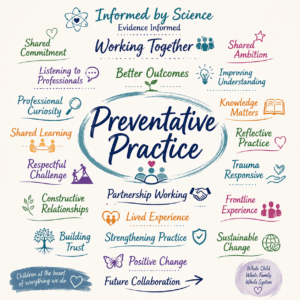
The distinction between preventative and reactive practice has become increasingly blurred within children’s services. Prevention is often described as intervening earlier, but earlier intervention is only preventative if it is informed by a sophisticated understanding of development. Without that understanding, interventions simply occur earlier within the same reactive system. Genuine prevention begins long before services become involved. It begins with knowledge. Professionals who understand developmental trajectories, cumulative adversity and neurodevelopment are better placed to recognise predictable patterns, ask different questions and identify support before difficulties become entrenched. Prevention is therefore not simply a service response; it is the natural consequence of professional understanding.
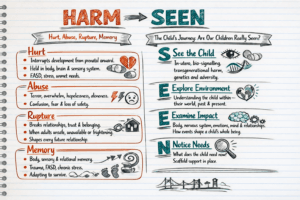
This thinking sits at the heart of the HARM Seen framework developed by PATCH. HARM Seen was never intended to become another model competing for attention. Instead, it was developed to encourage a different way of thinking about children. HARM reminds us that children’s development may be shaped by Hurt, Abuse, Rupture and Memory, not as isolated events but as cumulative experiences interacting over time. SEEN challenges professionals to respond differently by seeing the child through their developmental journey, exploring the environment surrounding them, examining the impact of adversity across multiple domains of development and noticing what the child genuinely needs. The framework is intentionally simple because its purpose is not to replace professional judgement but to strengthen it. It encourages curiosity before conclusion and understanding before intervention.
The Child In Focus discussions reached a similar conclusion. Rather than recommending additional specialist training in isolation, the open letter argued for the development of a National Knowledge Framework that reflects contemporary scientific understanding of child development and provides a shared foundation across health, education, social care, justice and policing. This is not an argument for every professional becoming a neuroscientist or psychologist. It is an argument that professional judgement can only be as strong as the knowledge upon which it is built. Where knowledge is inconsistent, assumptions inevitably fill the gaps. Those assumptions influence assessment, assessment influences intervention and intervention ultimately shapes children’s lives.
It is here that I believe we need to ask ourselves a more difficult question. Why, despite increasing professional agreement and a growing evidence base, does meaningful change remain so slow? There are obvious explanations. Public services are under considerable pressure. Caseloads are high, resources are stretched and reflection frequently competes with immediate operational demands. Those realities should never be dismissed. However, they do not fully explain the reluctance to critically examine long-established assumptions when new evidence becomes available.
Perhaps the more uncomfortable explanation is that systems, like individuals, can become attached to their own certainty. Practices become embedded because they are familiar rather than because they continue to represent the strongest available evidence. Over time, organisational habits become accepted truths. Reflection becomes increasingly difficult because questioning established practice may feel like questioning the competence of those who developed it. Yet every profession depends upon exactly that process. Medicine evolves because it is willing to replace outdated knowledge with better knowledge. Engineering evolves because evidence changes. Psychology evolves because understanding develops. Children’s services should be no different.
This is why I find myself increasingly reflecting on the idea of strategic ignorance. I do not use the phrase to suggest that professionals deliberately ignore evidence or that organisations consciously choose poorer outcomes for children. Rather, I use it to describe something quieter and perhaps more pervasive: the tendency for systems to avoid asking questions that might require fundamental change. Strategic ignorance is not always the rejection of evidence. Sometimes it is the failure to actively seek it, the reluctance to critically examine existing assumptions or the acceptance of reactive practice as though it were inevitable.
If we genuinely believe in preventative practice, then our systems must reflect what we now know about child development. They must value professional curiosity as highly as professional compliance. They must encourage reflection rather than defensiveness and recognise that strengthening knowledge is not an optional extra but the foundation upon which better decisions are made. Most importantly, they must begin to understand children before they ask how to manage them.
Perhaps, then, the debate is no longer about whether change is necessary. The science has moved forward. Professional consensus is growing. Lived experience continues to tell us the same story. The work produced through PATCH and endorsed by professionals from multiple disciplines reflects that growing consensus. The more pressing question is whether children’s services are prepared to evolve alongside that knowledge, or whether we will continue to describe ourselves as preventative while operating systems that remain fundamentally reactive.
Ultimately, the choice is not between tradition and innovation. It is between allowing contemporary knowledge to shape practice or allowing established practice to determine which knowledge we choose to accept. If we are serious about improving outcomes for children, that is a question we can no longer avoid.